RUSSIA: Tsarskoe Selo and Saint Petersburg’s Suburban Landmarks
Saint Petersburg, (Russian: Санкт-Петербург) formerly known as Petrograd and later Leningrad, is the second-largest city in Russia after Moscow. It is situated on the River Neva, at the head of the Gulf of Finland on the Baltic Sea. As Russia’s cultural center, it is considered an important economic, scientific, and tourism center of Russia and Europe. In modern times, the city has the nickname of being “the Northern Capital of Russia”.
Saint Petersburg has a significant historical and cultural heritage. The city’s 18th and 19th-century architectural ensemble and its environs is preserved in virtually unchanged form. For various reasons (including large-scale destruction during World War II and construction of modern buildings during the postwar period in the largest historical centres of Europe), Saint Petersburg has become a unique reserve of European architectural styles of the past three centuries. Saint Petersburg’s loss of capital city status helped it retain many of its pre-revolutionary buildings, as modern architectural ‘prestige projects’ tended to be built in Moscow; this largely prevented the rise of mid-to-late-20th century architecture and helped maintain the architectural appearance of the historic city centre.
Details of the iron gate of Winter Palace with Imperial eagle at the top
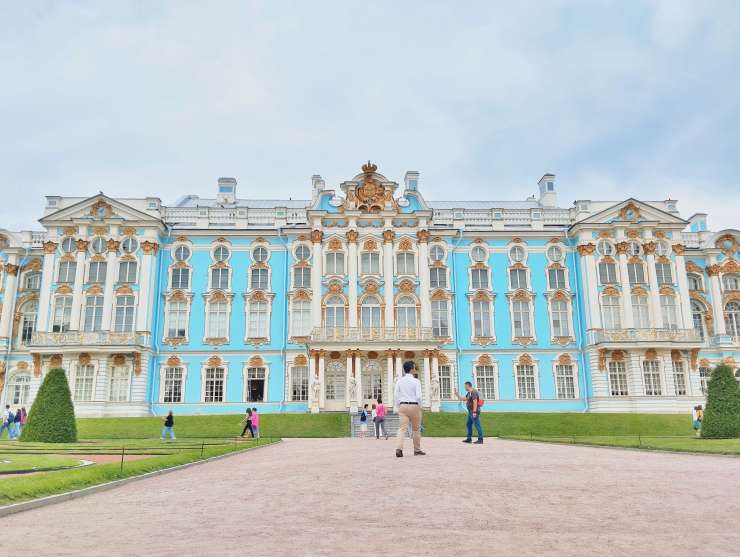
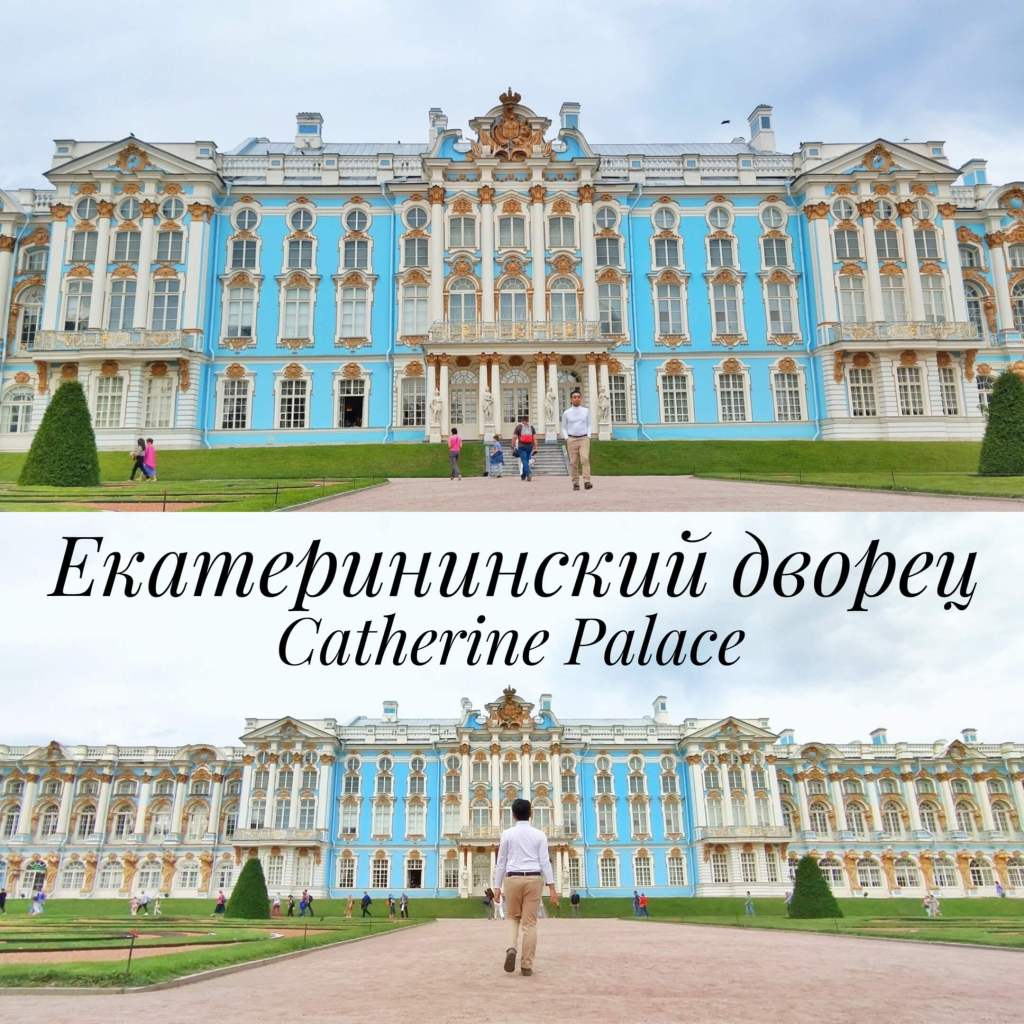
Southern suburbs of the city feature former imperial residences, including Petergof, with majestic fountain cascades and parks, Tsarskoe Selo, with the baroque Catherine Palace and the neoclassical Alexander Palace, and Pavlovsk, which has a domed palace of Emperor Paul and one of Europe’s largest English-style parks. I initially planned to visit the famous Petergof Palace but at the time of my visit, it was closed to the public. Hence, I turned to Catherine Palace at Tsarskoe Selo and I was not disappointed. I was glad to choose this one as an alternative. It was a majestic trip on the suburbs.
The Historic Centre of Saint Petersburg and Related Groups of Monuments is the name used by UNESCO when it collectively designated the historic core of the Russian city of St. Petersburg, as well as buildings and ensembles located in the immediate vicinity as a World Heritage Site in 1991. The site was recognized for its architectural heritage, fusing Baroque, Neoclassical, and traditional Russian-Byzantine influences. The historical center of Saint Petersburg was the first Russian patrimony inscribed on the UNESCO list of World Heritage Sites.
In this post, I’ll show the highlighted attractions on the outskirts of historic core below and explain their significance in city’s historical fabric that led them to be inscribed in UNESCO World Heritage List. Attractions within Central Saint Petersburg are discussed in this post.
The Saint Petersburg metropolitan area as a whole, and its historic centre in particular, have preserved their integrity. This has to do with the fact that the development of the historical centre practically ceased in 1913, and in 1918 the capital was moved to Moscow. As a result, new construction projects and the growth of industrial zones occurred outside the limits of the historic centre. Its integrity is ensured through the preservation of its planned layout, silhouette and opportunities for an unobstructed view, but high buildings and inappropriate development around the property have been an issue. The property also suffers from the impacts of traffic, air pollution and relative humidity.
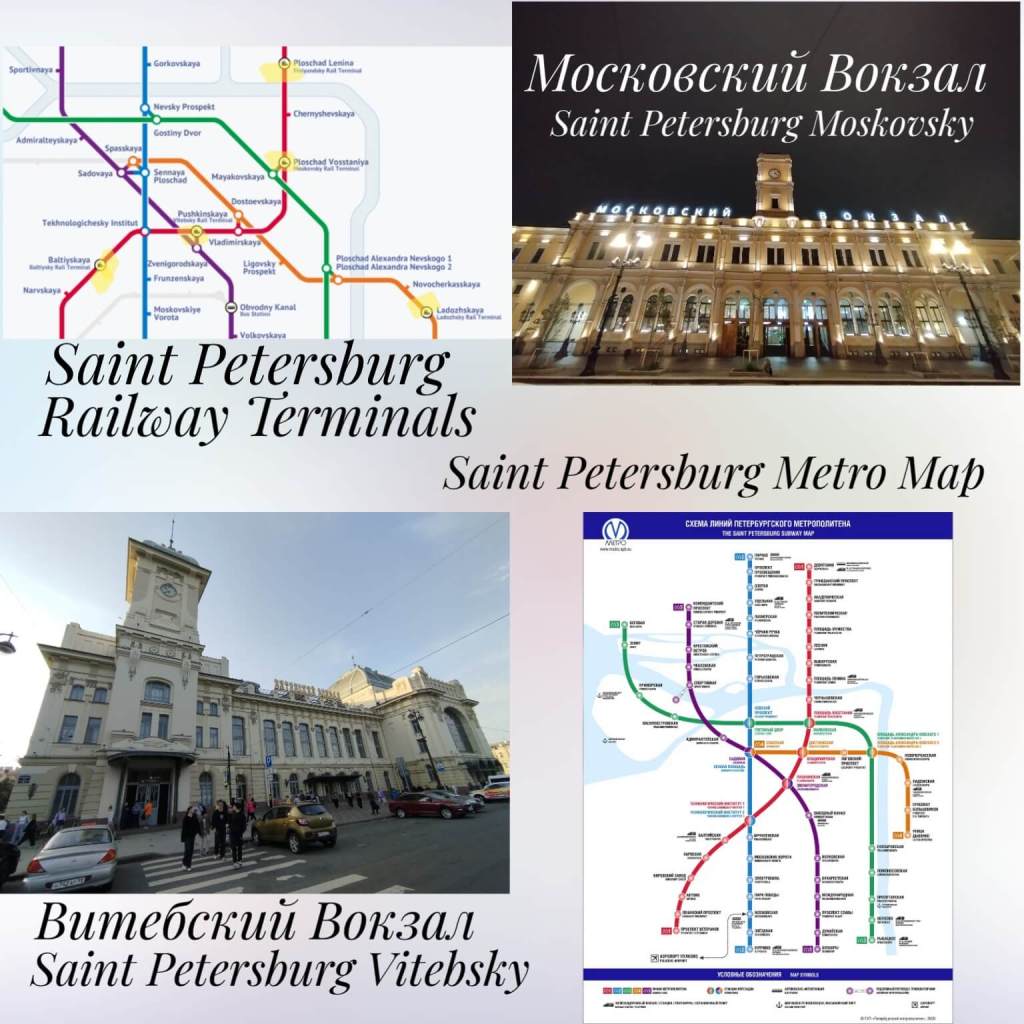
Ploshchad Vosstaniya (Russian: Плóщадь Восстáния, lit. ‘Uprising Square’) is a station on the Kirovsko-Vyborgskaya Line of Saint Petersburg Metro. It is one of the system’s original stations, opening on November 15, 1955. It is a deep underground pylon station at 58 metres (190 ft) depth. The main surface vestibule is situated on Vosstaniya Square, which gives its name to the station. Another exit (opened in 1960) opens directly into the Moskovsky Rail Terminal. Ploshchad Vosstaniya is connected to the station Mayakovskaya of the Nevsko-Vasileostrovskaya Line via a transfer corridor and a set of escalators.
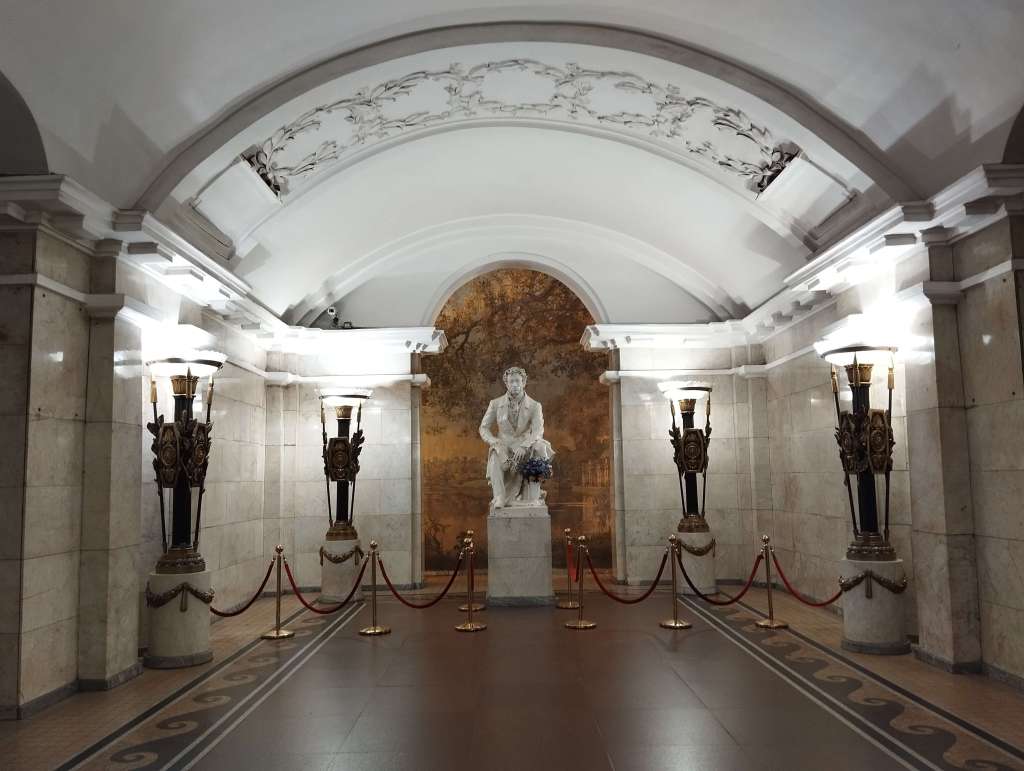
Pushkinskaya (Russian: Пу́шкинская) is a station of the Saint Petersburg Metro. It first opened on 30 April 1956, under the original name of “Vitebskiy vokzal”, referring to the connecting Vitebsky railway station. There is a monument in the station dedicated to the poet Alexander Pushkin sculpted by Mikhail Anikushin. This station was the first USSR metro station with memorial located under the ground.
St Petersburg-Vitebsky (Russian: Ви́тебский вокза́л) is a railway station terminal in Saint Petersburg, Russia. Formerly known as St Petersburg-Tsarskoselsky station because its first line led to the suburban royal residences town of Tsarskoye Selo, it was the first railway station to be built in Saint Petersburg and the whole of the Russian Empire (while its present-day building is much newer). Later, with considerable extension of its lines, the station was renamed after a much farther destination – Vitebsk, a city in Belarus.
Pushkin (Russian: Пу́шкин) is a municipal town in Pushkinsky District of the federal city of St. Petersburg, Russia, located 24 kilometers (15 mi) south from the center of St. Petersburg proper, and its railway station, Tsarskoye Selo, is directly connected by railway to the Vitebsky Rail Terminal of the city.
Tsarskoye Selo (Russian: Ца́рское Село́, lit. ’Tsar’s Village’) was the town containing a former residence of the Russian imperial family and visiting nobility, located 24 kilometers (15 mi) south from the center of Saint Petersburg. The residence now forms part of the town of Pushkin. Tsarskoye Selo forms one of the World Heritage Site Saint Petersburg and Related Groups of Monuments. The town bore the name Tsarskoye Selo until 1918. The new Bolshevik government of Soviet Russia renamed it as Detskoye Selo (Russian: Детское Село, lit. ‘Children’s Village’), which it held from 1918–1937. At that time, it was renamed under Stalin’s government as Pushkin (Russian: Пушкин) after the famous Russian poet and writer. It is still known by that name.
Pavilions like this with a name taken from the French language were a common feature of regular gardens in the eighteenth century. They were intended to enable the owner of the estate to rest and dine in the company of a select few and were located in the “wild” area of the park. In order to avoid the inhibiting presence of servants, such pavilions were usually fitted with mechanisms that enabled the tables to be raised and lowered. The Hermitage pavilion in the Regular Park (the Catherine Park) at Tsarskoye Selo was originally designed by Mikhail Zemtsov. The laying of the foundations began in the spring of 1744 and was completed by autumn that same year. In 1749, however, the facades of the pavilion that was by that time built were reconstructed in accordance with a new project devised by Rastrelli. The unique signature of Empress Elizabeth’s chief architect is present in the exceptionally complex aspects that the building presents to the viewer when seen from close by.
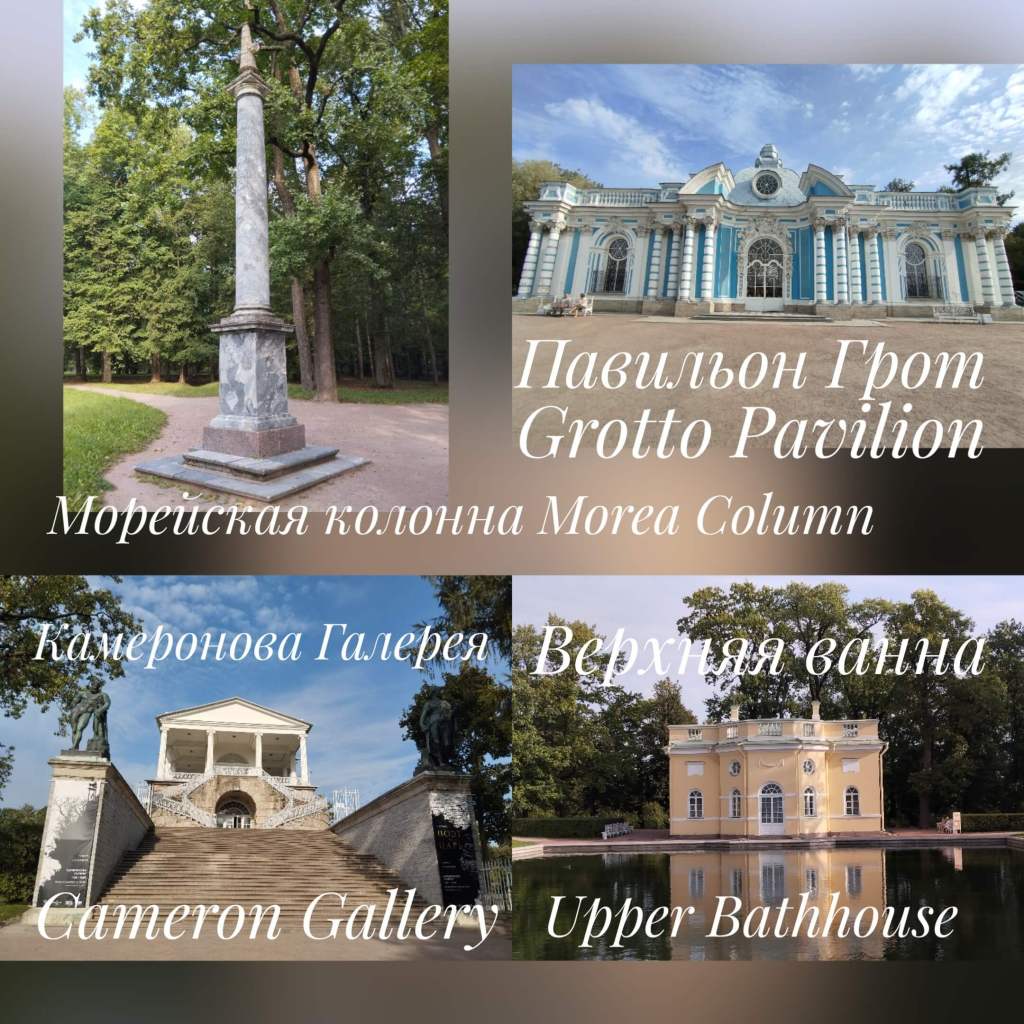
The Morea (or Small Rostral) Column was set up at the junction of three alleys in the regular part of the Catherine Park, by the cascade between the first and second Lower Ponds as a monument to successes in the Russo-Turkish Wars. The column was erected in 1771, on the orders of Empress Catherine II, to mark in particular the Russian victory won under the command of Count Fiodor Orlov at the Morea peninsula in the Mediterranean. A grotto pavilion decorated inside with seashells and tufa (porous limestone) was an invariably feature in Western European regular parks of the eighteenth century.The project for the construction of the Grotto on the bank of the Great Pond in the Catherine Park was drawn up by the architect Rastrelli. Most of the work to construct it was carried out in 1755–56 under Empress Elizabeth, but it was completed in the 1760s under Catherine II. The Cameron gallery that Empress Catherine II was conceived as a place for strolls and philosophical conversations. Charles Cameron created for her is located on the slope of a hill on the boundary between the regular and landscape areas of the Catherine Park near the Catherine Palace. On the edge of the Mirror Pond in the Catherine Park stands the Upper Bathhouse pavilion that was constructed in 1777–79 by the architects Vasily and Ilya Neyelov. The Upper Bathhouse was designed in the early Classical style. Although the facades of the pavilion are almost devoid of decorative embellishments, it creates an impression thanks to the proportional relationship of the main body and the three-sided projection that protrudes towards the pond.
The Catherine Palace (Russian: Екатерининский дворец, romanized: Yekaterininskiy dvorets) is a Rococo palace in Tsarskoye Selo (Pushkin), located 30 kilometres (19 mi) south of St. Petersburg, Russia. It was the summer residence of the Russian tsars. The palace is part of the World Heritage Site Saint Petersburg and Related Groups of Monuments. Following the Great Northern War, Russia recovered the farm called Saari Mojs (a high place) or Sarskaya Myza, which resided on a hill 65 m in elevation. In 1710, Peter the Great gave the estate to his wife Catherine I, the village of which was initially called Sarskoye Selo, and then finally Tsarskoye Selo (Tsar’s Village).
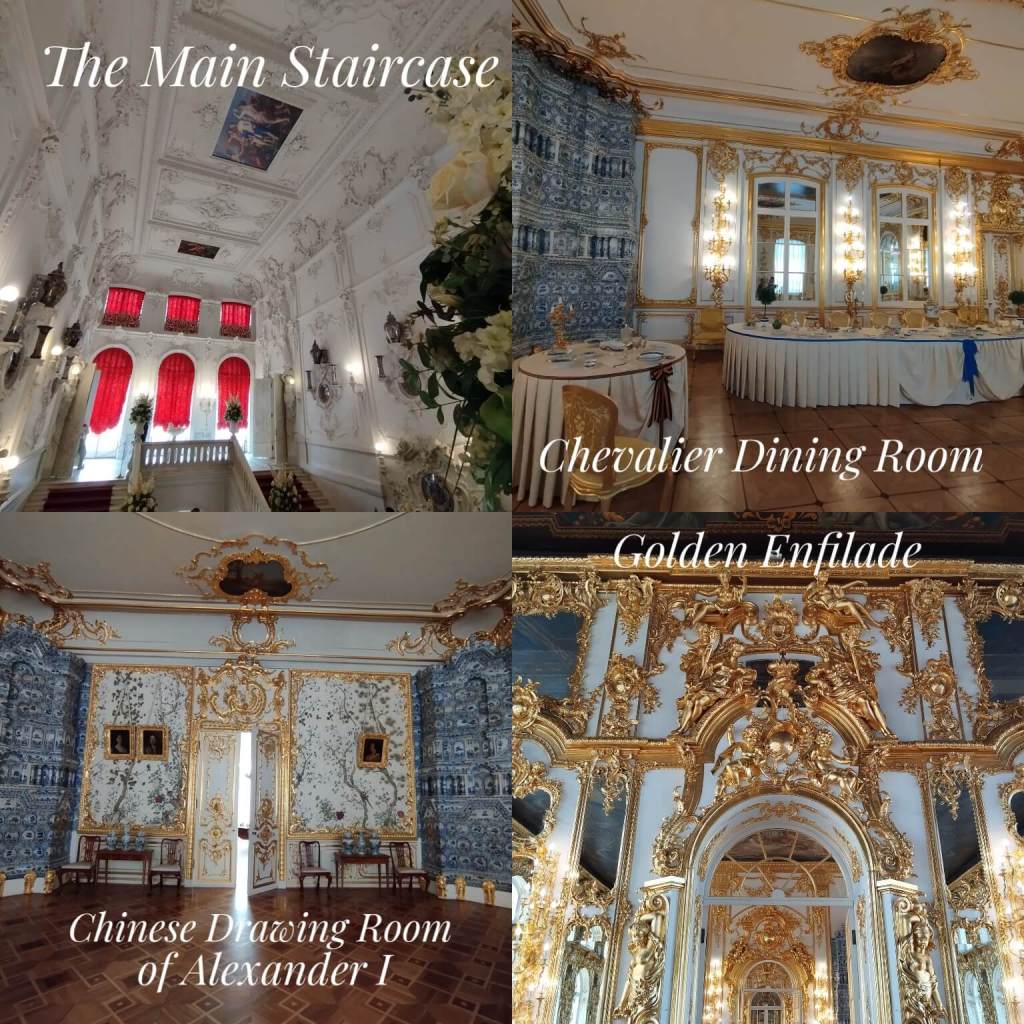
There are 3 palace tours you can choose from when visiting Catherine Palace but the first one is the most popular route. Palace Tour 2 is not available at the moment and Palace Tour 3 has no Amber Room included. At spring and summer times, Palace Tour 1 is currently not combined with Palace Tour 2, and includes the following palace interiors:
Main Staircase
First & Second Antechambers
Chevalier Dining Room
Great Hall
White State Dining Room
Crimson Pilaster Room
Green Pilaster Room
Portrait Hall
Amber Room
Picture Hall
Small White Dining Room
Chinese Drawing Room of Alexander I
Pantry
Green Dining Room
Waiters’ Room
Stasov Staircase
The Great Hall or Bright Gallery, as it was called in the eighteenth century, is the largest state room in the palace. It was created to Rastrelli’s design between 1752 and 1756. The stylish hall with a floor area of over 800 square metres was intended as the venue for official receptions and celebrations, banquets, balls and masquerades. The hall occupies the whole width of the palace and has windows on both sides. Passing the Main Staircase of the Catherine Palace we reach the White State Dining Room by Rastrelli that was formerly intended for grand banquets and also evening meals taken by the empress in a small company of intimates. Since Empress Elizabeth’s time the walls of this room were lined with white damask that in combination with the gilded carvings gave the interior a special elegance. The Picture Hall, a state room of the Great Palace at Tsarskoe Selo (Catherine Palace) that is situated next to the Amber Room, gets its name from its original and distinctive décor – painted canvases arranged according to the “tapestry” principle was created to Rastrelli’s designs in the 1750s. The hall extends across the full width of the building and has a floor area of around 180 square metres. In the eighteenth century it was used for diplomatic receptions, meals and musical soirees. The Green Dining Room marks the beginning of the private apartments in the northern part of the palace that were created in the 1770s on the orders of Catherine II for her son, Grand Duke Paul (the future Paul I) and his first wife Natalia Alexeyevna. The pale green walls of the dining room are embellished with white moulded ornament, its motifs taken from wall-paintings in ancient villas.
In 1860–63 the Main Staircase was reconstructed by the architect Ippolito Monighetti. He produced a new one in marble stylized in imitation of the Rococo and decorated by elaborate carved balustrades and figured vases. The stairwell occupies the entire height and width of the palace and is lit by three tiers of windows on both east and west. The white marble steps ascend from both sides to a central landing from which four flights rise to the first floor where the state rooms are located. The first room beyond the Great Hall is the Chevalier Dining Room that was also created to Rastrelli’s design. It is not particularly large and so the architect placed mirrors and false windows containing mirrors on the walls, making the hall spacious and bright. The treatment of the interior is typical of the Baroque, dominated by carved and gilded ornament of stylized flowers and seashells. The gilded dessus-de-porte – over-door – compositions are particularly magnificent. The Chinese Drawing Room, created to the designs of the architect Rastrelli in 1752–56, belonged to the private imperial apartments. This interior stood out among the rooms of the Golden Enfilade on account of the silk lining the walls that was painted with watercolours in the Chinese manner. The rest of the décor followed the general style of the state rooms: a ceiling painting, carved and gilded dessus-de-portes designed by the sculptor Duncker, mirrors between the windows, stoves with “Hamburg” tiles and a patterned parquet floor. The palace is best known for Rastrelli’s grand suit of formal rooms known as the Golden Enfilade. It starts at the spacious airy ballroom, the “Grand Hall” or the “Hall of Lights”, with a spectacular painted ceiling, and comprises numerous distinctively decorated smaller rooms, including the recreated Amber Room.
The Amber Room (Russian: Янтарная комната, romanized: Yantarnaya Komnata, German: Bernsteinzimmer) was a chamber decorated in amber panels backed with gold leaf and mirrors, located in the Catherine Palace of Tsarskoye Selo near Saint Petersburg. From the Portrait Hall you can reach the Amber Room, the gem of the Catherine Palace and a sight that has been justifiably called one of the wonders of the world. Constructed in the 18th century in Prussia, the room was dismantled and eventually disappeared during World War II. Before its loss, it was considered an “Eighth Wonder of the World”. A reconstruction was made, starting in 1979 and completed and installed in the Catherine Palace in 2003.
Visitors arriving at Tsarskoe Selo in the mid-eighteenth century during the reign of Elizabeth Petrovna would find themselves first in the Antechambers adjoining the main staircase in the southern wing of the palace. These rooms were located before the Great Hall and were intended as places for people to wait before audiences and the public appearances of the empress. In the Crimson Pilaster Room visitors’ attention is drawn by the stove whose tiles are decorated with little scenes featuring personages in eighteenth-century costume and by the ceiling painting of The Clemency of Alexander the Great by an unknown late-seventeenth-century Italian artist. Adjoining the Picture Hall is the Small White Dining Room which was the first room in the personal apartments of Empress Elizabeth and after her of Catherine II, who in her turn passed them over to her favourite grandson, the future Emperor Alexander I. Charles Cameron split the Waiters’ Room, one of the service rooms in the eighteenth-century Great Palace (the Catherine Palace) at the time of Paul I, in two with a crosswise partition, making two anterooms, one of which was in semidarkness and led to the stairs.
Walking from bus stop towards Smolny Convent, you can see the building of the Administration of the Government of the Leningrad Region Управление делами Правительства Ленинградской области
Smolny Convent or Smolny Convent of the Resurrection (Voskresensky, Russian: Воскресенский новодевичий Смольный монастырь), located on Ploschad Rastrelli (Rastrelli Square), on the left bank of the River Neva in Saint Petersburg, Russia, consists of a cathedral (sobor) and a complex of buildings surrounding it, originally planned as a convent. This Russian Orthodox convent was built to house Elizabeth, the daughter of Peter the Great. After she was disallowed succession to the throne, she opted to become a nun. However, her Imperial predecessor, Ivan VI, was overthrown during a coup d’état (carried out by the royal guards in 1741). Elizabeth decided against entering monastic life and accepted the offer of the Russian throne. Work on the convent continued with her royal patronage.
The convent’s main church (catholicon or sobor), a blue-and-white building, is considered to be one of the architectural masterpieces of the Italian architect Francesco Bartolomeo Rastrelli, who also redesigned the Winter Palace, and created the Grand Catherine Palace (Yekaterininsky) in Tsarskoye Selo (Pushkin), the Grand Palace in Peterhof and many other major St. Petersburg landmarks. The Cathedral is the centerpiece of the convent, built by Rastrelli between 1748 and 1764. The projected bell-tower was to become the tallest building in St. Petersburg and, at the time, all of Russia. Elizabeth’s death in 1762 prevented Rastrelli from completing this grand design.
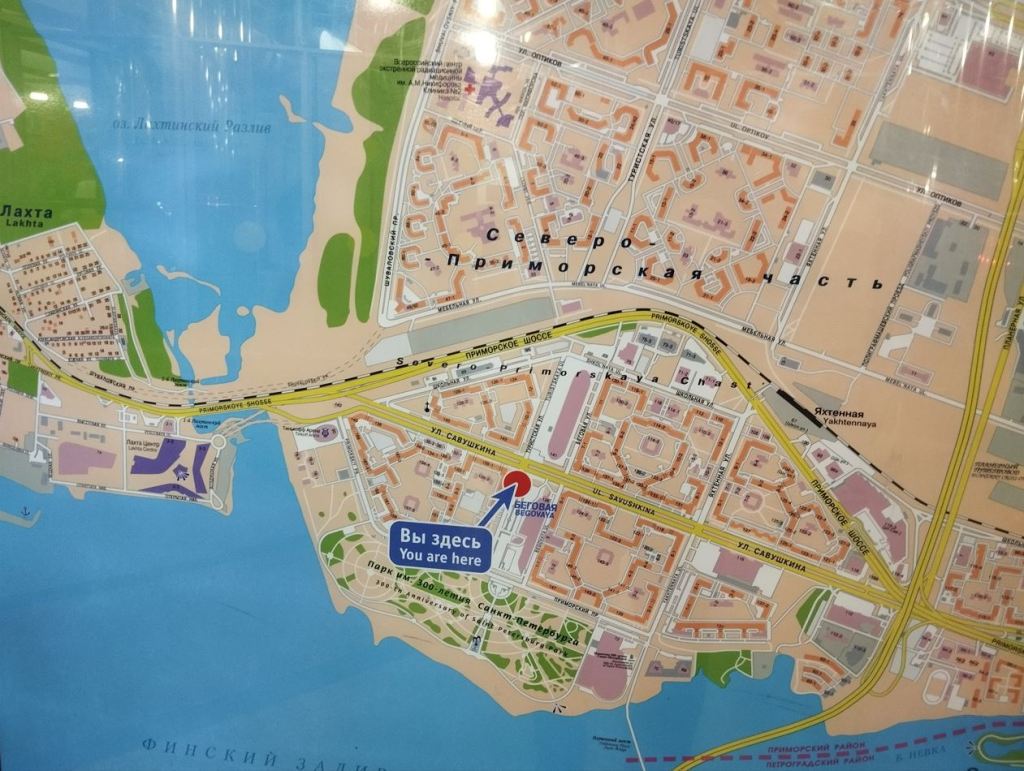
Begovaya (Russian: Беговая) is a Saint Petersburg Metro station on the Nevsko–Vasileostrovskaya Line (Line 3) of the Saint Petersburg Metro. It opened on 26 May 2018 as a part of the extension of the line to the north from Primorskaya. The extension included Novokrestovskaya station as well. Begovaya is the northern terminus of the line, behind Zenit.
From Begovaya Metro station, you can take a bus and alight at Europe’s tallest skyscraper.
The Lakhta Centre (Russian: Ла́хта це́нтр, romanized: Lahta tsentr) is an 87-story skyscraper built in the northwestern neighbourhood of Lakhta in Saint Petersburg, Russia. Standing 462 metres (1,516 ft) tall, it is the tallest building in both Russia and Europe, and the sixteenth-tallest building in the world. It is also the second-tallest structure in Russia and Europe, behind the Ostankino Tower in Moscow, in addition to being the second-tallest twisted building and the northernmost skyscraper in the world. Construction of the Lakhta Centre started on 30 October 2012, with the building topping out on 29 January 2018. It surpassed the Vostok Tower of the Federation Towers in Moscow as the tallest building in Russia and Europe on 5 October 2017.
Vosstaniya Square (Russian: Плóщадь Восстáния, romanized: Plóshchad’ Vosstániya, lit. ‘Uprising Square’), before 1918 Znamenskaya Square (Russian: Знаме́нская пло́щадь, lit. ‘Square of the Sign’), is a major square in the Central Business District of Saint Petersburg, Russia. The square lies at the crossing of Nevsky Prospekt, Ligovsky Prospekt, Vosstaniya Street and Goncharnaya Street, in front of the Moskovsky Rail Terminal, which is the northern terminus of the line connecting the city with Moscow. The Leningrad Hero-City Obelisk was erected on the spot of the former Alexander III monument in 1985 in commemoration of the 40th anniversary of Russian Victory Day. The obelisk received mixed reviews, as its design and style did not match that of the neo-classic square.
With Podorozhnik reloadable transportation card, you can navigate Saint Petersburg using metro, tram and buses from one point to another. Always use Yandex Maps! Be amazed! (n_n)











 Ben Goes Where
6 thoughts on “RUSSIA: Tsarskoe Selo and Saint Petersburg’s Suburban Landmarks”